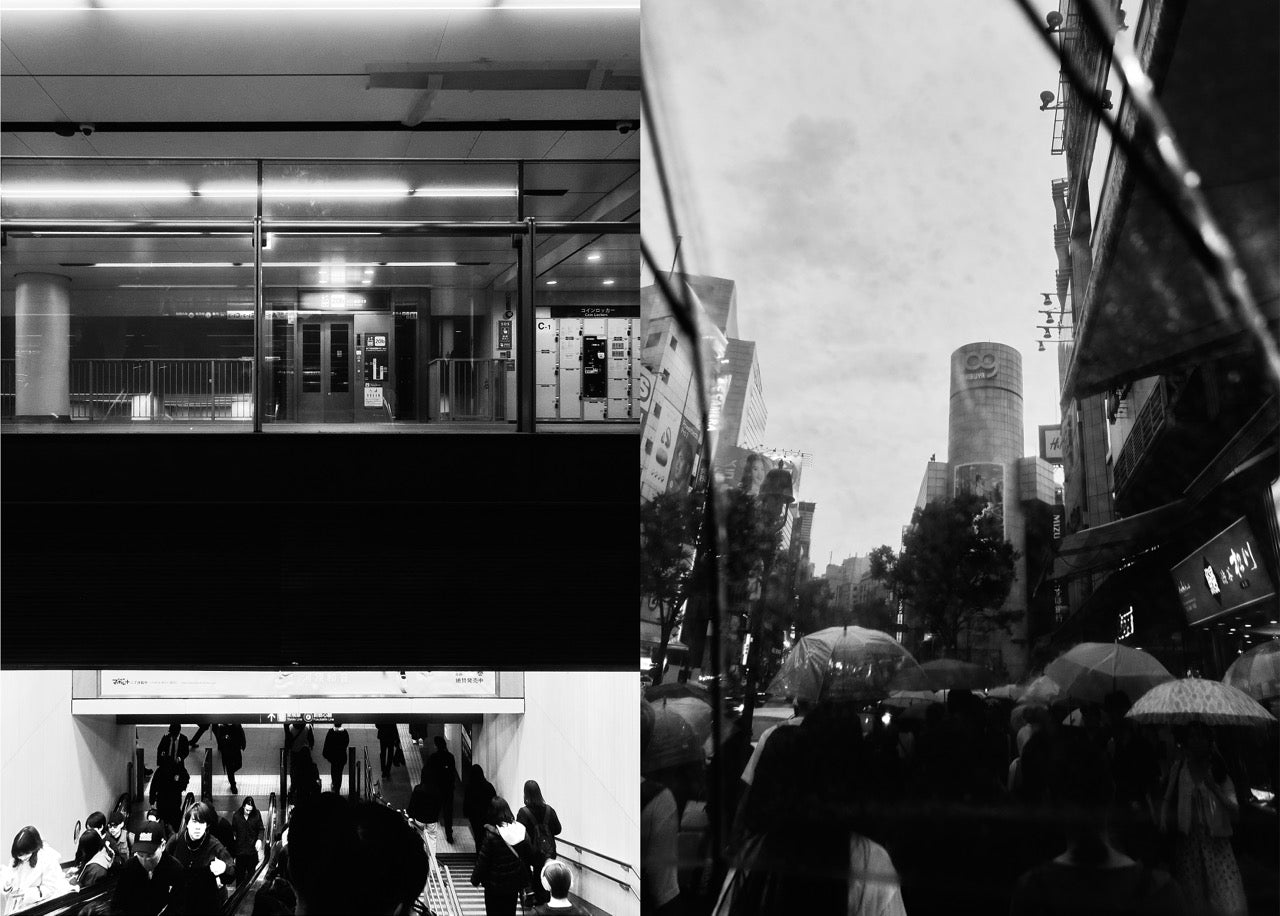
SHIBUYA 2025 - Ashen Reincarnation
SHIBUYA 2025 - Ashen Reincarnation
Couldn't load pickup availability
For over thirty years, I have lived and worked in Shibuya — not at its center, but at a considered distance, close enough to feel it, far enough to see it.
During that same time, I turned my lens toward cities around the world. Cities that preserved their old beauty intact. Cities where new buildings appeared with every visit. How has the consciousness behind city-making transformed, and under that consciousness, what is created, what is irreversibly lost? That question drove my work — until one day, the lens turned toward the city beneath my own feet. The turning point was the demolition of Tokyu Honten. On the wall of Bunkamura, standing beside the rubble, an artwork had been carved — rising like an apostle announcing the collapse of a city.
The signs of change had been visible long before the apostle's arrival. The character of the crowds along Center-gai had shifted. The bookshops that once held the cultural edge had vanished. Seibu had withdrawn. Hands had been acquired. The scramble crossing was being absorbed by global tourism capital. What I had seen for years without truly seeing came suddenly into focus the moment I looked at that artwork. The end of the Shibuya I knew had been underway for a long time.
"Reincarnation," in its original sense, presupposes the continuity of the soul. Even in death, its essence is carried forward into the next life. But what is happening in Shibuya is something altogether different. Concrete turns to ash, and upon that ash, new concrete is raised. Form, to be sure, is reborn. But the soul is not carried forward. The memory of place, the cultural context, the accumulation of time — these are erased in the name of redevelopment, replaced by a uniform city without character, and what should have been reincarnated is instead reduced to ash, painted over in grey.
I have no intention of joining the chorus that romanticizes the past and laments that things were better before. And yet, that loss cannot be measured in numbers. The hours spent in Tower Records. The view from the rooftop of Seibu. The smell of music, cigarettes, and culture that once breathed in the darkness of back alleys. The warmth of bodies pressed close, and the wet, particular atmosphere of this city. These disappear without being recorded — surviving only in the memory of those who knew them, fading as those memories fade. I have only just realized, looking at that artwork, that I myself was part of what is disappearing. Cities must change. But the question is whether that change carries a soul with it.
This work is a record of a witness who arrived too late — a question pressed into form before the erasure was complete, an inquiry into "Ashen Reincarnation," the grey rebirth of a city.
Share